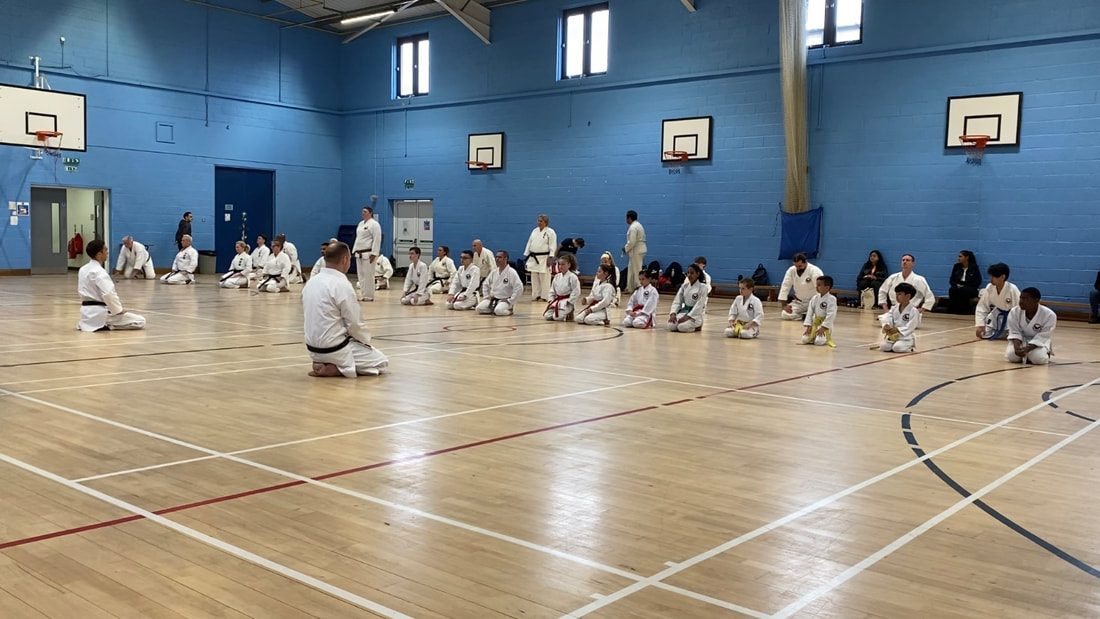
Etiquette
Karate begins and ends with courtesy
Courtesy, attitude, the dojo and what is expected in class. The traditions every student keeps, from the first session to black belt.
Courtesy
Karate begins and ends with courtesy. No one is qualified to be a karate person without courtesy, even if they exceed others in their technique.
Courtesy is pursuing karate-do for the purpose of seeking peace and showing your deep respect for others. When we pursue karate-do we try to learn the theory and its application from our predecessors, and treat these seniors with due respect and courtesy. In return they treat us with due regard and consideration.
Attitude
Steady and hard effort can produce miracles. Diligence is firmly rooted in the practice of bushido, the way of martial arts, and helps us overcome the difficult situations we all encounter.
Sweep preoccupying thoughts from your mind before training and concentrate on all movements with maximum vigour.
Karate requires harmony between breath and action. We must learn to adjust our breathing until each breath coincides with each movement during practice.
Karate practice must finish by observing the essential idea that karate begins and ends with courtesy, so we end practice by bowing with decorum.
The dojo
"Dojo" means place of learning or training hall. It is the place where courage is fostered and the strength of human nature is bred through hard work. It is the place where discipline and the practice of respect and courtesy must be the most important thing in your mind.
- Always bow as you enter and leave the dojo. This forms part of your humility and respect for the others in the hall, and shows your willingness to do your best at every session.
- Sit on the floor during break times, or remain standing.
- Remove your shoes before entering the dojo, where practical.
- Do not eat in the dojo.
- Remove all jewellery before training.
- Make sure your gi (uniform) is clean and your finger and toenails are kept short and clean.
- Always address the instructor as "Sensei" and any assistants as "Sempai".
- Do not leave the dojo without your instructor's knowledge and permission. If you feel unwell, the instructor must be informed.
In class
- Always show your seniors (by grade) respect, and do not ask higher grades to spar.
- There should be no contact during sparring (kumite).
- Do not push for grading. You may ask when you are ready for grading, but accept the instructor's decision.
- Always follow the instructions you are given and maintain a good attitude at all times.
- Respect your training partners.
- Arrive for training 15 to 20 minutes early. Use this time to stretch and warm up for the class. There should be no unnecessary noise. If another class is running, sit quietly until your class starts. Once you enter the dojo you should not leave without your Sensei's acknowledgement.
- If you are late for the class, get the instructor's attention, quietly stand near the side of the hall, bow, then enter the class by walking behind the lines and joining in at the appropriate place.
The mastery of karate-do
He is human and so am I.
I cannot develop my own potential when trapped in self-limitation. I must discard this self-limitation. If he practises three times, I must practise six times.
Do not depend on others for your improvement. Cultivate your mind as well as your body, and believe in yourself.
Karate-do can be referred to as the conflict within yourself, or a lifelong marathon that can only be won through self discipline, hard training and your own creative efforts.